
Analytical methods for characterizing carbohydrate structures on therapeutic proteins is of utmost importance due to their role in clearance and mechanism of action.
The most common techniques for carbohydrate profiling involve high-performance liquid chromatography (HPLC), mass spectrometry (MS) and capillary electrophoresis (CE). For several biotechnology companies, CE has become the method of choice due to high peak efficiencies and speed of analysis(1).
To overcome the potential difficulties associated with characterizing minor peaks seen in CE analysis, CE-MS is emerging as a powerful solution with continuous advances in separation capability, MS sensitivity and assay robustness.
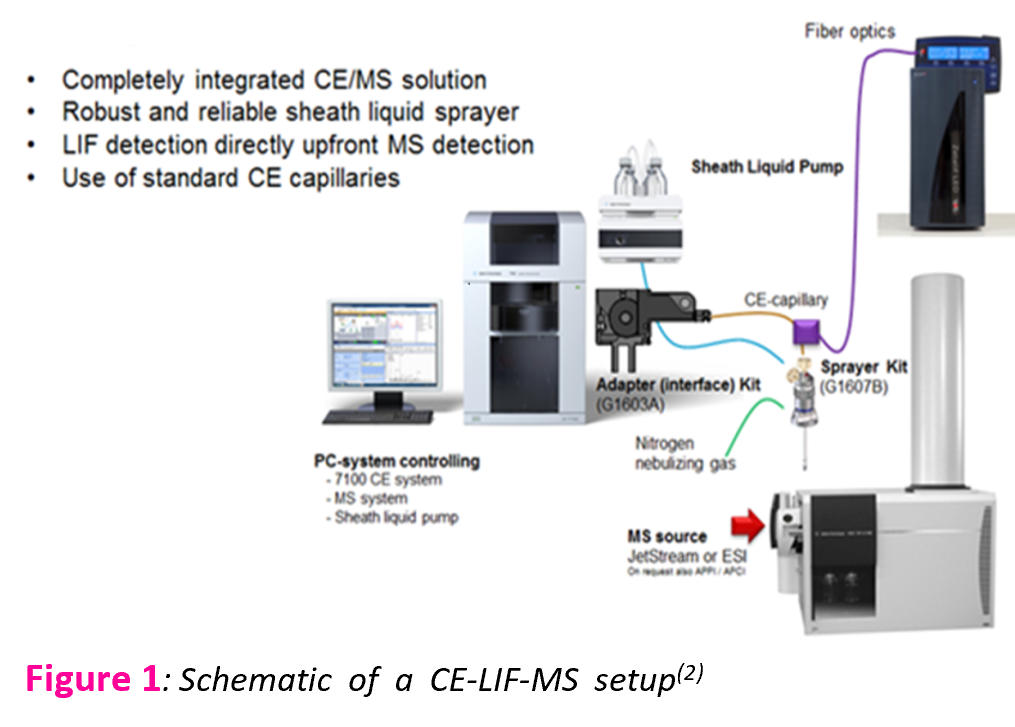
A typical CE-MS system involves CE instrumentation which has been configured to allow external detection. In this mode, the capillary inlet is placed in the inlet buffer, while the capillary outlet exits the instrument and is placed within an electrospray MS source. For on-line LIF detection, the small Picometrics detection cell is placed upstream of the electrospray tip, and is held in place by an adjustable arm. A schematic of this instrumentation is shown in Figure 1(2).
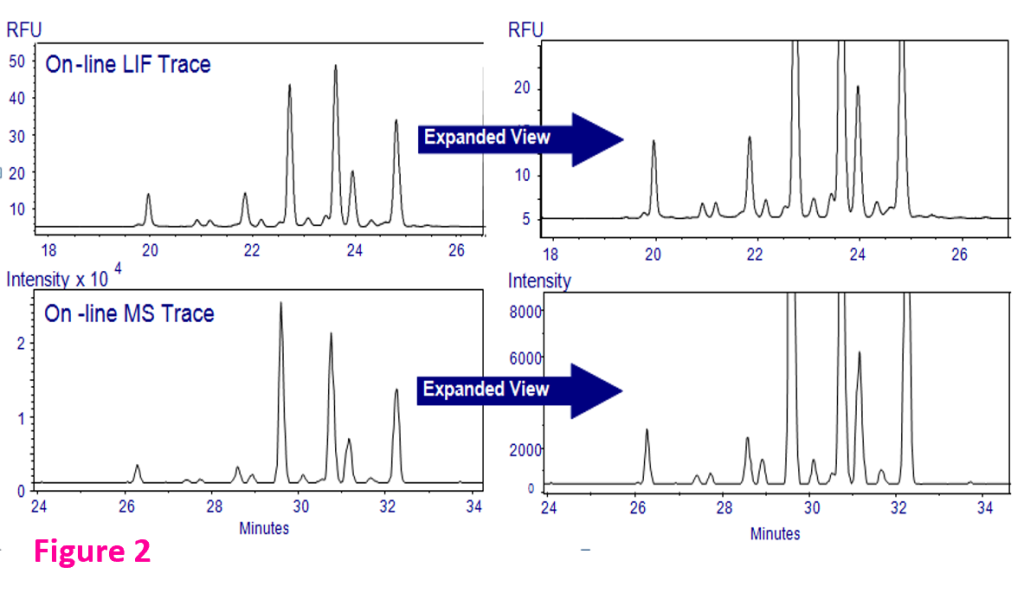
In this arrangement, both LIF and ion intensity signal can be obtained within the same analysis, therefore enabling accurate comparisons of the two electropherograms.
Several researchers have used CE-MS technology successfully to elucidate structures of complex carbohydrates.
In an industrial setting, CE-MS is being used as a characterization tool for identifying peaks in routine assays involving UV or laser-induced fluorescence (LIF) detection. However, comparing electrophoretic profiles between CE-LIF and CE-MS can often be challenging due to possible differences in peak resolution and sensitivity.
To overcome this obstacle, a Picometrics ZETALIF LASER system was used to allow on-line LIF detection in conjunction with CE-MS analysis (2).
This on-line CE-LIF-MS technology has been used successfully for the direct identification of minor carbohydrate species(2).
An example is shown in Figure 2, wherein carbohydrates from a therapeutic MAb are analyzed by on-line CE-LIF-MS and minor species can be accurately identified and quantified.
Instruments | Capillary electrophoresis: Agilent CE Detector: Picometrics ZETALIF Laser: laser, 488nm, 25 mW |
Sample | Monoclonal antibody (mAb) carbohydrates released with PNGase F |
Reagents | Derivatization agent: 1-aminopyrene-3,6,8-trisulfonate (APTS) |
Method | Capillary: 100cm x 50 µm ID PVA coated. LIF detection is occurring 20 cm upstream from the electrospray tip. Buffer: 40mM epsilon-aminocaproic acid pH 4.5 Voltage: -30 kV Injection: 30 seconds at 50 mbar PMT: 850 V |
Acknowledgment
We are extremely grateful to Lynn A. Gennaro, Protein Analytical Chemistry, Genentech Inc., South San Francisco, California, for implementing the present method, but also for sharing the present data with Picometrics and Agilent Technologies and so strongly collaborating to the constant improvement of the solutions that we promote.