Routine analysis of common designer drugs is a major concern in doping control, surveillance of drug substitution, clinical toxicology, as well as forensic science. Method sensitivity is often an issue since many drugs possess a high volume of distribution, resulting in low concentration levels.
Capillary electrophoresis (CE) hyphenated with laser-induced fluorescence (LIF) can be a useful tool for determining such substances, especially when small sample are available.
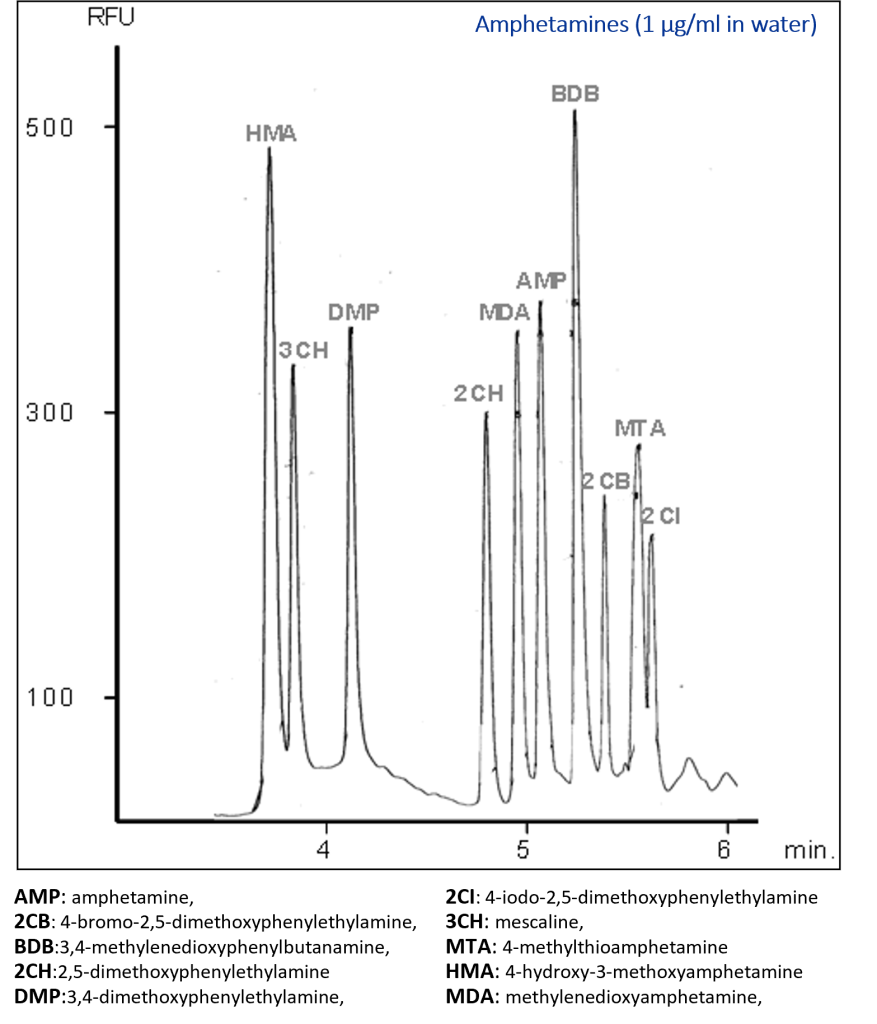
Analysis of ten amphetamine derivatives was performed by CE-LIF at 410 nm and very low limits of detection were obtained.
Limit of Detection* :
10 ng/mL, i.e., 48-74 Nm
Depending on the considered molecule * Estimated for a S/N of 3
CE-LIF | CZE-DAD 200nm | |
LOD | 10 ng/ml | 200 ng/ml |
CE-LIF 410nm electropherogram of 10 amphetamine derivatives
Instruments | – Capillary electrophoresis : Agilent CE – Detector : Picometrics ZETALIF detector – Laser : Diode laser, 410 nm, 15mW or – HeCd laser, 442nm, 40 mW. |
Sample | Standard solution of amphetamines derivatives in water |
Reagents | Derivatization agent : Naphthalene Dicarboxaldehyde (NDA) |
Method | Capillary : 50 µm ID, 43 cm effective length Buffer : borate 10 mM (pH 9.5), SDS 30 mM, ACN 10 % Injection : 40 mbar, 7 s (estimated injected volume = 9 nL) Voltage : 30 kV Rise time : 0.5 s PMT : 650 V |