
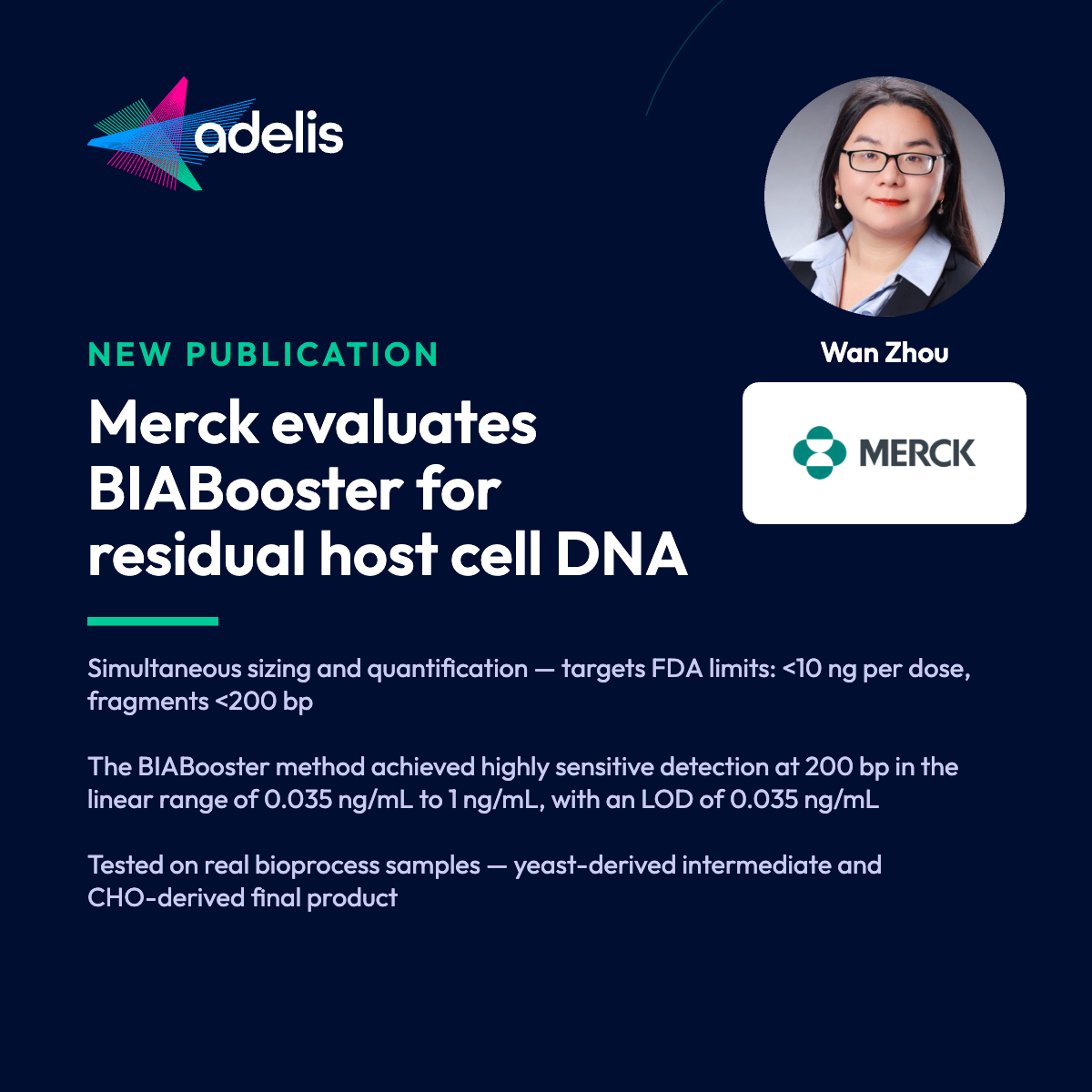
A team from Merck & Co. has published a study in Analytical Chemistry on residual host cell DNA in biopharmaceutical samples. The authors evaluated our BIABooster technology for the simultaneous sizing and quantification of DNA fragments in real bioprocess samples.
Why residual DNA needs monitoring
Biological products such as vaccines and therapeutic proteins are made in host cells. After purification, DNA traces from these cells can remain in the product. WHO and FDA recommendations set two limits for final products: less than 10 ng per dose and fragments shorter than 200 bp. However, meeting both criteria with a single method remains a technical challenge. For example, qPCR quantifies specific sequences but gives no size information. Similarly, fluorescence assays, Southern blot and agarose gels each show limits in selectivity, speed or reproducibility.
The Merck Analytical R&D study
The authors work in Analytical Research & Development at Merck & Co. in Rahway, New Jersey. Their proof-of-concept study compares two capillary electrophoresis platforms. On one side, they tested BIABooster, a single-capillary system based on µLAS technology. On the other, they used the Agilent Femto Pulse system for comparison. In addition, agarose gel electrophoresis served as a confirmation method.
Sizing and quantifying residual host cell DNA with BIABooster
In the BIABooster capillary, a pressure-driven viscoelastic flow opposes electrophoresis. This principle concentrates and then separates DNA molecules, which supports lower detection limits. The team optimized several parameters. Notably, using the gel buffer as sample diluent reached ≤3% RSD, compared with up to 20% with water or TE buffer. They also adjusted detector and injection settings to balance sensitivity and run time.
On a 200 bp standard, the authors report a limit of detection of 0.035 ng/mL and a limit of quantification of 0.065 ng/mL. Moreover, intermediate precision remained at or below 2.5% RSD across days, preparations, analysts and capillary lots.
Results on real bioprocess samples
The team tested two matrices. The first was a yeast-derived in-process intermediate, rich in residual DNA. The second was a CHO-derived final product with low DNA content. Spiked fragments of 200, 400 and 1000 bp served to assess sizing accuracy in both extracts. In the yeast sample, BIABooster revealed a DNA smear above 300 bp. By contrast, the CHO sample contained mostly fragments below 200 bp. Some fragments below 100 bp were detected qualitatively, outside the range of the DNA 1K kit used.
Two complementary approaches
According to the authors, both platforms reach the sensitivity needed to address regulatory limits for residual host cell DNA. BIABooster showed slightly higher sensitivity and required no extensive dilution after extraction. Meanwhile, Femto Pulse offers higher throughput and a wider size range. Therefore, the authors describe the two technologies as complementary. As next steps, they mention more complex matrices and an integrated workflow combining lysis, extraction and analysis. For this work, our team provided training on the BIABooster capillary.
Practical information
- Title: Sensitive and Robust Capillary Electrophoretic Analysis of Host Cell Residual DNA in Biopharmaceutical Samples
- Journal: Analytical Chemistry (ACS Publications), 2026
- Authors: Laura N. Taylor, Paul F. Gillespie, Richard R. Rustandi, Matthew Schombs, Adam T. Sutton, Wan Zhou
- Affiliation: Analytical Research & Development, Merck & Co., Inc., Rahway, New Jersey
- DOI: 10.1021/acs.analchem.6c04185
- Link: https://pubs.acs.org/ancham/article-abstract/98/36/27043/5351094/Sensitive-and-Robust-Capillary-Electrophoretic
- Technology: BIABooster, developed by Adelis, Labège, France